People often try to paint EMS with a broad brush and describe it the same everywhere in the country. Nothing could be further from the truth. I have described EMS as the Green Beret of healthcare, and that comparison fits in many ways. EMS professionals operate in unpredictable environments, integrate into the community, solve problems with limited resources, and are trained to perform under pressure, but that is where many of the similarities end. The difference between rural EMS and urban or suburban EMS is significant. The structure of the service may look similar on paper, but the real difference lies in the mindset of the provider.
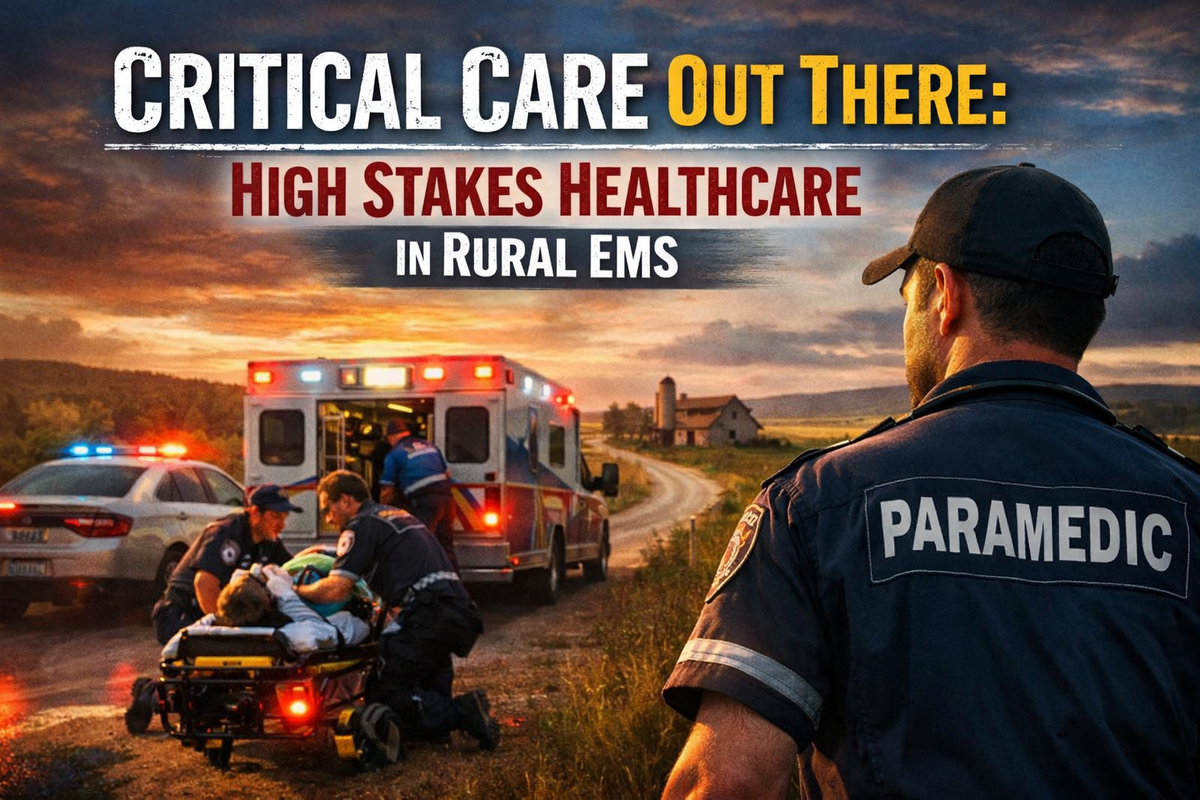
Rural EMS requires a different way of thinking. Many people imagine EMS as simply getting the patient to the emergency department and letting the hospital take it from there. That mindset does not fit the operating environment in many rural communities. This is especially true in Mississippi, where healthcare deserts and financially strained rural hospitals are a reality. The closest hospital may not have the diagnostic tools, specialty coverage, or inpatient capacity a patient truly needs. Because of that, rural EMS providers must approach their work with the mentality of a clinician who is delivering dynamic, high-quality healthcare in a high-stakes environment. Call it….High Stakes Healthcare, because we understand the patient’s outcome is heavily influenced by what happens before they ever touch a hospital bed.
Research from the American College of Surgeons highlights just how different the rural EMS environment is. Across all levels of patient severity, EMS call times in rural communities average about 92.8 minutes compared with 74.1 minutes nationally. Rural providers are also seeing a higher proportion of critically ill or injured patients, with high-acuity calls making up roughly 39.3 percent of responses compared with 26.4 percent nationally. When those severe cases occur, the timeline stretches even further. Total call times for high-acuity patients average about 97.1 minutes in rural areas compared with 69 minutes nationwide, and when those patients must be transported to specialty centers the time expands to around 155 minutes compared with 114 minutes nationally.
This data illustrates rural EMS providers operate in a system where patients are often sicker. When you combine that with long transports and limited destination options, you are no longer practicing “short interval medicine.” EMS providers are providing advanced medical care with little to no additional resources, in a highly chaotic dynamic environment, with little to no direct oversight. It is CRITICAL CARE OUT THERE. Afterall, critical care is not a location or a destination, it’s a different way of thinking about medicine.
That shift in mindset changes everything. Rural EMS providers are not simply focused on stabilizing a patient long enough to reach the nearest emergency department. The focus becomes much deeper. The goal is to consider what care and interventions will shorten a patient’s hospital stay, improve outcomes, and reduce long-term complications. Instead of asking what might make the patient look slightly better in the moment, clinicians begin asking deeper questions. What is happening physiologically? What direction is the patient trending? What actions now will truly influence the outcome later? When definitive care may be an hour or more away, EMS providers must understand pathophysiology, the relationships between perfusion and oxygen delivery, ventilatory mechanics, and how medications interact with cellular receptors to produce specific physiological effects. In essence, rural EMS clinicians serve as the bridge between the initial medical event and the definitive care the patient ultimately needs.
This environment also changes how protocols are used. In shorter transport systems, strict protocol-based care can often get the patient safely to the hospital. In rural EMS, protocols become guidelines to support critical thinking rather than replace it. Skilled clinicians learn how to work within those guidelines while addressing the patient’s needs. They have the knowledge and confidence to contact a physician and request additional orders and interventions when needed. They understand what a medication is going to do to afterload, preload, heart rate, respiratory drive, and mental status, because you might be managing those effects for the rest of the trip. Sedation is not just “keep them comfortable,” it is keeping them comfortable without destroying blood pressure or losing the ability to assess neuro status. Fluids are not just “open the line,” they are a decision about perfusion versus pulmonary edema, hemorrhage versus dilution, and whether you are helping the patient or quietly worsening the situation. Pressors are not magic, and if you do not understand the physiology underneath, you can easily make a number look better while organs still die.
The truth is, in a lot of rural Mississippi, the paramedic may have more capability than many of the small rural healthcare facilities. That is not a knock on rural hospitals. It is simply the reality of limited resources, limited specialty coverage, and the growing strain on rural healthcare. Mississippi leaders have publicly acknowledged the risk facing rural hospitals in the state, with warnings that a large portion may be at risk of closure. Even when a rural hospital remains open, it may not be able to deliver definitive care for the diseases that are most time sensitive. That means EMS professionals don’t just provide transportation, they provide quality healthcare in the dynamic mobile environment.
This becomes especially important with time-sensitive diseases. Stroke care is a clear example. Research on endovascular thrombectomy has shown that earlier treatment significantly reduces disability at 90 days, with benefits declining as time passes. Rural EMS providers must recognize the signs of stroke early and determine whether the patient needs transport to a facility capable of advanced neurological intervention, even if it means bypassing a closer hospital. The same principle applies to acute myocardial infarction. Cardiology systems emphasize rapid reperfusion, commonly reflected in the goal of a 90-minute door-to-balloon time for PCI. Early recognition of STEMI, early activation of the system, and choosing a destination based on capability rather than proximity can significantly influence patient survival and recovery.
Sepsis is another condition where early recognition and treatment matter. Rural populations often face longer transport times, older patient demographics, and limited access to immediate diagnostics. Recognizing the pattern early, supporting perfusion, beginning resuscitation, and communicating effectively with receiving facilities can dramatically influence the patient’s trajectory. Trauma presents similar challenges, as patients who appear stable at first may deteriorate during long transports. Anticipating that decline and managing shock, airway, and ventilation during extended transport requires experience and clinical judgment.
Mississippi is also working to reduce maternal and infant mortality across the state, and rural EMS will play an important role in that effort. Some of the highest mortality rates occur in rural areas where healthcare access is limited. Early recognition of high-risk obstetric emergencies and rapid transport to facilities capable of advanced maternal care will be a critical part of improving outcomes for mothers and infants.
All of this comes back to one important idea. Rural EMS is not simply a smaller version of urban high volume EMS. It is often higher-responsibility medicine practiced with longer timelines and fewer resources. In many communities, the difference between a patient returning home or living with permanent disability may not be determined inside the first hospital. It may be determined at the moment of first medical contact, and rural EMS providers own that.
That is why rural EMS deserves recognition not only as a vital public service but also as a challenging and meaningful career. It is medicine practiced where it matters most, often far from the traditional safety nets of healthcare. EMS clinicians who embrace this high-stakes healthcare environment bring knowledge, skill, and sound decision making to the earliest moments of a patient’s crisis. In doing so, they help shape the outcome long before the patient ever reaches the hospital.